
The following is a summary of Charles Taylor’s Politics of Recognition alongside personal musings

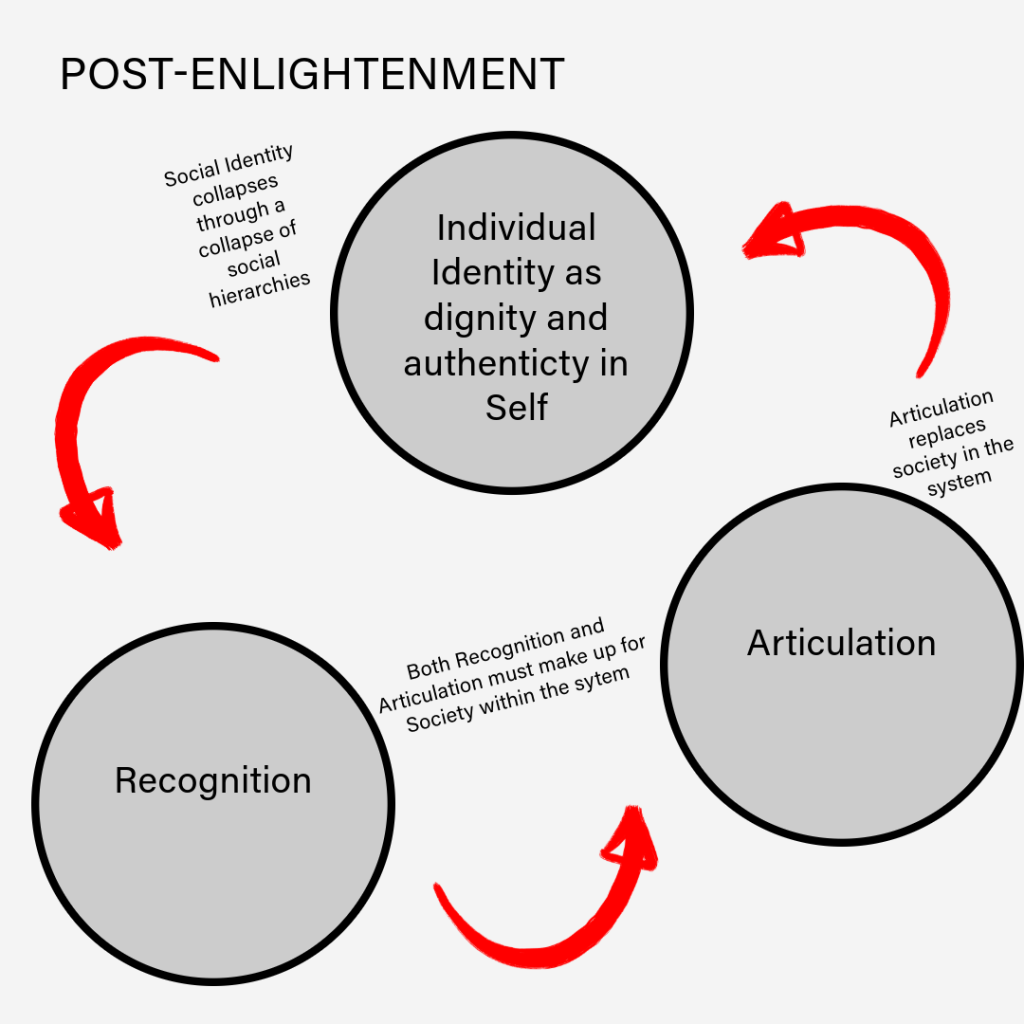
The birth of Social Identity
Pre-Enlightenment social identity was entirely dependent on both society and social hierarchy. In fact, intrinsic social hierarchies have been the sina qua non for ancient, traditional political models of identity and recognition. They affirmed hierarchies as metaphysical and ontological truths imbedded into the fabric of not only the cosmos, but also the fabric of society. Thus, an individual’s identity was premised on a system of honour and authenticity in the divine. Hierarchy acted as a first principle through which the premises of honour and authenticity naturally led to a person’s recognition in society.
Then, the advent of enlightenment thought ushered in a new age of scepticism, individualism, and societal independence. Thinkers like Descartes, Hobbes, Locke, and Rousseau gradually began to chip away at this classical metaphysical account of human autonomy in the name of the enlightenment revolution. It is necessary to note that this revolution was not born in a vacuum; It was concomitant with the three political revolutions of the age: The English, American and French.
Successfully breaking free from the shackles of the previous faulty political hierarchies required two considerations. Practically, the people would have to seize power but the theoretical justification behind the need for political freedom would be more important if they were to successively retain control. Their key to escaping the abusive monarchical systems was therefore a physical and metaphysical collapse of the social hierarchy. This leads us to our current reality.
As the threads of social hierarchy unwind, social identity becomes visibly frayed. A post-modern ideology of individual identity is presented as a more pragmatic and just solution. However, not only does this new identity have a natural desire, based on its contextual origins, to be independent of any societal influence, but is also transcendentally premised on two new systems of dignity and authenticity in self.
These systems are not intrinsic qualities of the self and are inherently subjective, making them reliant on articulation for external recognition. This recognition then goes on to feed the individual identity creating a mutually parasitic recursion that slowly reduces identity, and recognition over time. The dimension of society, which had been the source of energy for previous systems, is lost.
Ultimately, this is what leads to the increasingly cacophonous demands for recognition from the slowly diminishing identities of those wounded by post-enlightenment ideology.
Authenticity?
With the loss of authenticity in God, there seemed to be a vacuum left filling for many people. As the self becomes increasingly devoid of the spiritual, it reaches for alternatives. For romanticists, this alternative was found by placing authenticity in something external to the self, hence the spirit of nature. However, the reality of this spirit was never fixed and, as with all created beings, reliant on something outside itself. Without an ontologically fixed reality, which would have previously been the Divine, external authenticity loses all meaning. A person is forced to turn inwards, looking for authenticity and dignity in the self, which is a characterisation of the modern predicament. However, this does little to stay the fall towards meaningless.
Therapy?
Many modern therapies aim to repair an individual’s lost sense of self. The theory above would contend that, even if therapy could help one find their self, little would be achieved in the long term. Therapy is anything but a band-aid delaying the inevitable collapse of any meaningful identity for anyone that has fallen into this symbiosis. The only exception would be systems and individuals that inculcate a true social identity. The first level and second levels of such a system would be the family and local community, respectively.
For this reason, those that disagree with modern, liberal ideologies should be first and foremost concerned for people and striving to help. It is devastating to see people in this state.
 IYAANA
Leave a comment